


1. Elements that influence the braking of a vehicle
According to physics, braking is the conversion of kinetic energy (movement) into thermal energy, which reduces the speed of the vehicle.
Technicians estimate that in a moving vehicle the distribution of mass is 75% on the front axle and 25% on the rear axle. Therefore the front and rear brakes, brake pads and shoes should have different braking rates to avoid locking of the rear wheels.
We recommend
- Definition of brake.
Wikipedia
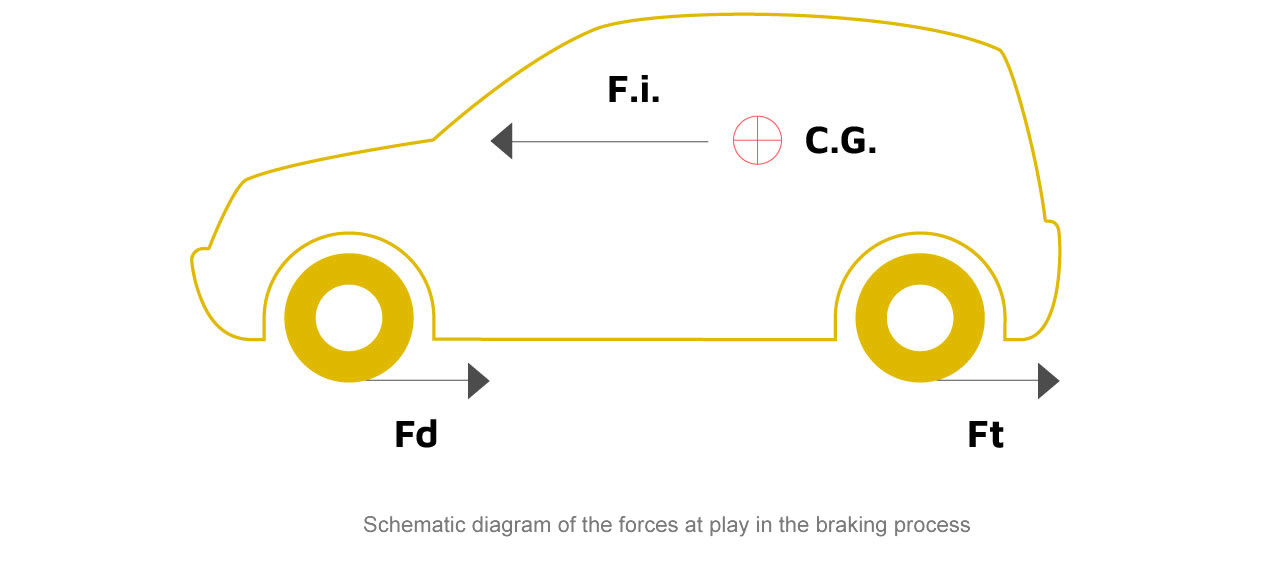
1.1 Let us look at the forces and moments acting in the braking process

Image by Bob Rohrman Honda Blog
Braking force: It is generated on the wheel surface when the wheels contact the road and when braking elements and engine power work together to slow down.
The critical limit is the grip between the tyre and the road. If this limit is exceeded, the tyres will lock up and slip on the road surface, with terrible consequences.
Rolling resistance: They have little effect at low speeds, but they do have an effect at high speeds. For example, when we go from 80 km/h to 160 km/h, the aerodynamic drag goes from 40 kg of thrust to 160 kg.
Aerodynamic actions: Apenas inciden en velocidades bajas pero sí lo hacen en altas velocidades. Por ejemplo, si pasamos de 80 km/h a 160 km/h la resistencia aerodinámica pasa de 40 kg de empuje a 160 kg.
Engine and transmission strength: This is another important element when braking a vehicle. When the engine is revving at high rpm, the vehicle slows down because the wheels are connected to the engine through the transmission.
Remember that on long descents, engine braking is very important to protect the brakes from overheating and wear. This effect is greater with diesel engines than with petrol engines because diesel engines have twice the compression ratio.
1.2 Most common brake problems
These are the most common problems:
The brake pedal has more to travel: Cuando pisamos el pedal del freno éste va hasta el fondo del recorrido sin oposición cuando lo normal es que vaya hasta la mitad.
The pedal is spongy: This is when the brakes are slow to respond when you apply them. It feels looser and more spongy than usual and is slow to respond.
You have to press harder to apply the brakes and so everything is inadequate.
The pedal is very hard and you have to press a lot: The pedal does not respond to the usual pedal force. It remains rigid and does not yield to our impulse when we step on it.
The pedal has less travel: When braking, you notice that the pedal moves less and does not return to its previous position.
A wheel is blocked: No matter how hard we apply the brakes, the wheel locks and we cannot manoeuvre our vehicle properly.
Brake pedal pulsation: You can feel vibrations when the brake pedal is depressed. They can be less noticeable or more severe.
Loss of efficiency during hot braking (fading): Brake fade occurs when the critical temperature point of the brake pads and discs is exceeded.
The car swings to one side: When braking the car swings to the right or left. A sign that something is wrong with the brakes.
The solutions to these problems can be found at this link.

2. Brake pads
2.1 What are brake pads?
One of the fundamental elements in stopping a vehicle, as they provide the friction necessary on the brake discs to slow the vehicle down.

The materials that make up brake pads are:
Fibres (10%): The most commonly used are glass, aramid and rock wool.
Mineral loads (27%): They give consistency to the assembly and resistance to abrasion. The most common are: barite, magnesite, talc, mica, carbonate, feldspar and others.
Metals (15%): Used in powder or chip form to homogenise the coefficient of friction and heat transfer from the pad to the calliper. They are brass, copper or bronze.
Lubricants (20%): They vary the coefficient of friction, usually downwards. They are used in powder form and are usually graphites, cokes, sulphides, anthracites, etc.
Organic binders (20%): They agglomerate the other materials when they reach certain temperatures. The most important are thermosetting phenolic resins, but various types of rubber, waxes, oils, etc. are also used.
Abrasives (8%): They increase the coefficient of friction and renew and clean the surface of the disc, allowing the formation of the so-called third layer, the intermediate layer.

2.2 Basic characteristics of brake pads
A quality pad requires the following characteristics:
Have an adequate coefficient of friction that is stable at all temperatures and pressures.
Maintain a balance between abrasion and wear resistance.
The pad material must absorb vibrations and irregularities of the other surface with which it comes into contact, which requires a certain degree of compressibility, both hot and cold.
Have good shock and cut resistance.
2.3 Brake pad components
 Underlayer: This is a layer of material that holds the friction elements in place and reduces the temperature that reaches the caliper. It is an additional element that can be avoided in the process.
The support: This is a metal part that holds the friction material in the brake pad holder of the calipers. It should be as flat as possible to avoid cracks between the support and the friction material.
Noise-absorbing films: As the name suggests, these accessories prevent noise by absorbing the vibrations caused by the contact between the pad and the disc.
Springs: These allow the pads to move slightly during braking to absorb the vibrations.
Acoustic warning devices: These are millimetre-sized strips that rub against the disc when the pad is worn and make a constant squeaking noise, warning that the pads need to be replaced.
Illuminated warning light: This is a conductive cable which, when rubbed against the disc, lights up to warn you that the pads need to be replaced.
2.4 What the brake caliper- pad tandem looks like
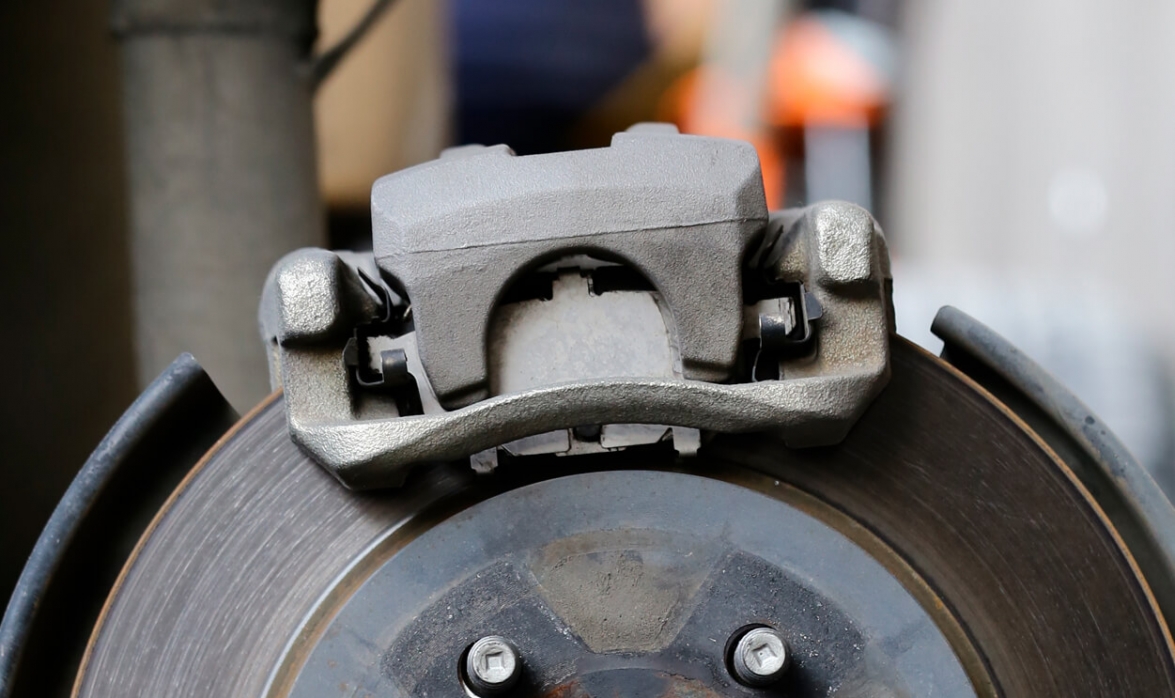
Here are the components that make the brake caliper-pad assembly so important:
- The caliper body provides rigidity and supports the pads.
- The pistons press the pads against the disc.
- The vent opens the assembly and allows air to escape from the circuit.
- The clips hold the pins in place and prevent them from slipping out.
- The pins hold the pads in place and act as a guide.
- The brake pads rub against the disc.

2.5 Things to remember when removing and fitting brake pads
This is an operation that requires dexterity because it is very important and any failure will have consequences on the vehicle’s braking system with corresponding safety and economic implications.
We must therefore remember that:
- It is always necessary to replace the brake pads on both wheels of the same axle.
- We must use brake pads suitable for the vehicle model.
- The pads must always be new. Do not use material that has already been used.
- The pads and discs must not come into contact with lubricants, grease, animal products or cleaning agents, as this may cause the brake system to fail. In this case, the material must be replaced.
- Use suitable tools. For example, they must not have sharp edges that could damage the brake pads. The manufacturer will specify the type of tightening for which a torque wrench must be used.
- Never use compressed air to clean the brakes.
- Fine dust can be harmful if inhaled; so take care not to create it.
- Use a mask if there is no good ventilation.
- Watch out for brake fluid leaks as this can cause extensive damage.
- When the operation is complete, check that the brake system is functioning.
We recommend
Always have your brake pads removed and fitted by a workshop you trust.
2.6 Pad wear problems
No two pads wear the same, and they may even wear asymmetrically. Let us look at the causes:
- The inner pad wears faster because it is closer to the piston and comes into contact with the disc sooner. The outer pad only comes into contact indirectly.
- If the difference in wear difference is exaggerated, the brake system should be checked, as some parts of the system (cylinder piston or caliper pins) may be affected.
- If the brake cylinder is not properly maintained, the piston rubber may break and the piston barrel may rust from the inside. Remember that the pistons drive the brake pads so that they rub against the discs.
- If the guide pin of the brake caliper is rusted the movement of the calipers will be affected and the braking forces will be unevenly distributed, resulting in wear of the brake pads.
- Another cause of wear is failure to maintain the brake calipers, which can lead to corrosion and poor piston return, resulting in overheating. In addition, this corrosion can affect the movement of the piston, delaying braking.

2.7 When should the brake pads be changed?
This is a recurring question when it comes to vehicle braking systems. We must remember that excessive wear on brake pads and discs can lead to serious risks, which are best avoided.
- When we drive on mountain roads or with heavy loads, we must remember that the braking effort is greater and we should check the brakes more often.
- Do not exceed 20,000 kilometres without servicing.
- When the pad thickness is reduced to 2-3 mm, it is necessary to replace the pad.
- Remember that the front pads wear out sooner than than the rear ones.
- Keep an eye on the warning light on the dashboard and when it comes on, change them.
- Listen for a metallic sound when braking as this is a sign that the brake pads are worn.
- We must change the pads on the same axle at the same time, both left and right.
- After changing the brake pads, we must be aware that they need a period of acclimatisation to achieve optimum performance.
- We will choose reliable manufacturers who guarantee quality.

2.8 The function of the grooves on the surface of the brake pads
The grooves on the surface of the brake pads are called slots and the edges are called chamfers.
What do they do?
The slot: It evacuates the dust generated by friction, preventing it from sticking to the disc and scratching it; it eliminates braking noise and accelerates air circulation by dissipating the heat generated by friction.
The chamfers: They reduce noise and allow the new pad to adapt and fit better to the end of the disc.

2.9 The importance of regular brake pad checks
By checking the brake pads regularly, we will always have a vehicle in good condition and with guaranteed safety. Brake pad wear depends on how the vehicle is driven and whether it is subjected to heavy braking or emergency braking.
What should be checked?
Brake pad thickness: Pay attention to the degree of wear as it has a direct effect on braking quality. If it is worn by 5 mm, it should be replaced immediately. If it is worn, the driver will notice that the pedal needs more travel or that braking has deteriorated.

3. Brake Discs
3.1 What are brake discs?
This is the surface that the brake pads rub against to stop the vehicle as the disc rotates in tandem with the wheels. The friction between the discs and the pads converts kinetic energy into heat energy, which causes a reduction in speed.

3.2 What is the function of brake discs?
As well as converting energy, the discs must ensure that the heat generated is dissipated as quickly as possible, otherwise the high temperatures reached would cause the braking system to fail.
The discs must therefore perform two functions: one is to move the air around them like a fan and the other is to transfer its energy to the atmosphere, like a radiator.
3.3 Brake disc components
The material from which the vehicle’s discs are made is grey nodular graphite lamellar cast iron. This component guarantees stable performance throughout their service life.
The industry is researching other types of materials, e.g. silicon carbide, but poor heat dissipation makes them impractical for the time being.
Basic composition nodular grey lamellar graphite cast iron contains 92-93% iron, with the remaining 7% being carbon, silicon, manganese and other materials.
 3.4 The importance of brake disc geometry
 3.4 The importance of brake disc geometry
The geometry is always the same: a perfectly flat circular surface, from which solutions are sought to dissipate the heat stored in the disc.
Parts of a brake disc
- Surface of the brake rotor: The surface on which the friction between the pad and the disc takes place. The heat dissipation varies according to the geometry and if it is not fully achieved, deformations, cracks and deposits of friction material can occur and damage the disc without any possibility of resolution.
- Mounting: Located in the central part of the disc. There is a bore where the hub is fixed and around it there are other bores that allow the anchor bolts to pass through to the wheel.
- The drum: This is the cylinder that connects the belt to the mounting plate.
- The thermal filter: A machined channel that separates the rotor surface from the mounting to reduce heat transfer from the rotor surface to the drum. These channels prevent the rim and tyre from overheating.
3.5 Proper maintenance of brake discs
Many drivers think that brake discs, as hard metal parts, should never be checked or replaced. However, we know that maintenance of the entire braking system is essential.
- Discs are not infinitely rigid and like any other part, will deform.
- The torque value of the wheels is very important to avoid such deformation. The tyres must be fitted according to the parameters recommended by the manufacturer. Do not use air wrenches as they can deform the discs, causing vibrations, noise and even breakage of the rim itself.
- Check the discs every 20,000 km. This should not only be done visually, as there is a minimum thickness after which the disc must be replaced.
- Check not only the thickness but also the warpage: if it is greater than 0.125 mm, the disc should be replaced. The driver may notice this warping as vibrations occur in the steering wheel when braking or, if more severe, pulsations in the pedal.
- Disc flatness is another point to check. If it is not within the specified values, hot spots or judder may appear and cause vibration when braking.
- Check for the appearance of rust if the vehicle is in a damp environment. This is not usually a major problem, as this rust tends to disappear with braking, but it is something to look out for if it persists.
- If there are deep circular scratches or numerous radial cracks, the discs must be replaced immediately.
- Remember that the discs must be replaced in pairs and the brake pads must be replaced even if they have not reached the end of their service life.

We recommend
Always have your brake discs removed and fitted by a reliable workshop.
3.6 What are the main problems with brake discs?
Most problems could be avoided by paying more attention to the assembly, by a careful visual inspection of the components.
The solution to all these problems is to replace the discs and pads.
- Incorrect tightening: overtightening causes cracks in the surface of the drum that rests on the hub. This problem can also be caused by not following the correct sequence and torque pressure.
- Incorrect installation of the caliper: If the caliper is not incorrectly fitted, the pads will wear irregularly, conically and asymmetrically, resulting in very loud braking noises.
- Excessive play in the hub bearings causes uneven wear on the disc brake bands, leading to overheating in the area of friction with the brake pads.
- Incorrect cleaning of the hub: Failure to properly clean the contact surface of the disc on the hub when fitting a new disc can result in an unstable fit, causing oscillation that damages the disc.
- Excessive temperature: An increase in temperature changes the material structure of the discs, even creating zones of cementite, an iron structure that causes vibrations and even cracks and changes the coefficient of friction.
- To avoid this problem, drivers should brake gently and progressively for the first 250-300 km and afterwards avoid overheating the brakes.
- Wear beyond the maximum limit: If the disc is used beyond its useful life, a reduction in disc mass occurs, resulting in poor heat dissipation, overheating and the appearance of cracks and stains.
- Cracked discs: Cracks are caused by excessive heating, making the disc more brittle and even causing it to break. This problem can be recognised by the strong vibrations felt in the pedal and steering, as well as a loud noise.
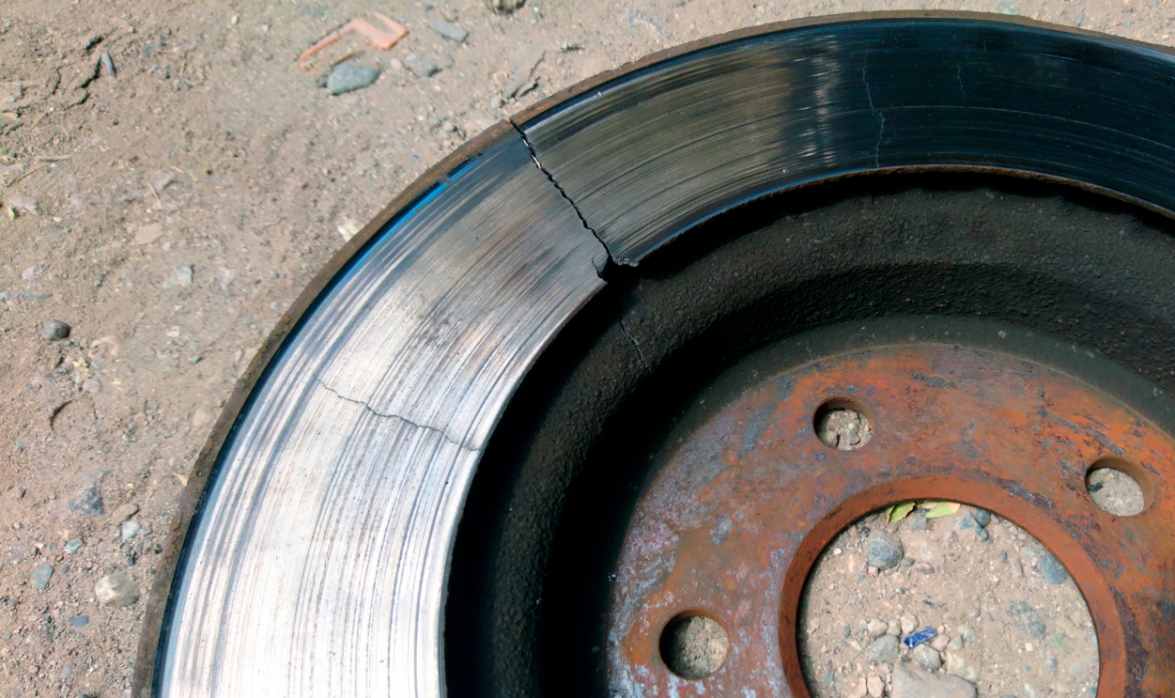
- Excessive disc wear due to total pad wear:
- This causes metal-to-metal contact between the disc and the pad, resulting in very abrasive wear with deep grooves. When this happens, braking becomes less effective and noise occurs.
- Disc damage due to vitrification of the friction material
- This occurs when the friction material is of poor quality and on vehicles with heavy braking requirements, such as delivery vans.
- These problems occur when high resin content pads are used to facilitate production.
- Grooves and deep scratches: These are caused by the interposition of various foreign materials between the brake pad and the brake, which may have been introduced during driving, or by a poor mixing process or foreign elements during manufacture.
- Deposits of friction material from the discs, which may have adhered due to high temperatures. This is a typical problem of low quality friction materials.
Follow us


3.7 The importance of regular disc inspection
The discs are an essential part of the braking system, so a regular technical inspection is an important safety precaution.
What should be checked during such an inspection?
- The appearance of annular grooves after a long period of use: If the groove is more than 1 mm or there are cracks on the surface, it is best to replace the disc.
- The presence of rust: If the rust has not disappeared after several braking operations, the disc should be disassembled and cleaned to remove the rust.

4. Regulation and Approval of brake pads and discs
Brake pads and brake discs supplied to workshops and users must comply with strict regulations and have the following approval certifications.
- ECE R-90 quality certificate for brake pads
5. Remsa brake pads and discs
Remsa produces brake pads and brake discs for the aftermarket professionals, with results comparable or superior to the original equipment of the most popular European vehicles. The best replacement brake components for passenger cars, commercial and industrial vehicles.

REMSA PRODUCTS
Get to know our range of products for cars and commercial vehicles: brake pads, brake disc, brake shoes.



Comentarios
No Comments