


The truth is that tribology is one of the least known sciences to the general public (the term was first used at the end of the 20th century), but it is essential to know how, for example, braking works in a vehicle.
The definition tells us that tribology is the science and technology that studies the contact between moving surfaces and related problems such as wear, friction, adhesion and lubrication.
This shows us that there are several phenomena in the interaction between two surfaces, the knowledge of which is vital. Basically, there are three such phenomena:
- Friction: It is caused by the existence of tangential forces that occur between two solid surfaces in contact when they remain connected by the existence of normal stresses.
- Wear and tear: It consists of the disappearance of material from the surface of a body as a result of interaction with another body.
- Adhesion: The ability to generate normal forces between two surfaces after they have been held together. That is, the ability of two bodies joined by the previous generation of bonding forces between them to hold together.
Tribology is present in virtually all moving parts. So we have:
- Minimal wear and friction: bearings, gears, cams… thanks to lubrication and coatings.
- Minimum wear and maximum friction: brakes, clutches, tyres… with wear-resistant materials.
- Maximum wear and minimum friction: pencils, deposition of solid lubricants by sliding.
- Maximum friction and maximum wear: erasers.
Let’s look at some situations to get an idea of the importance of solving tribological problems. Take cars, where there are more than 2,000 tribological contacts, and tribological improvements can lead to an estimated 18.6% energy saving.
On the other hand, in the energy sector, in the United States it is estimated that 11% of the total energy consumed in four major sectors – transportation, turbomachinery, power generation and industrial processes – can be saved by introducing tribological advances. From an economic point of view, a report carried out in Germany showed that losses due to friction and wear amount to an annual energy waste of the order of twenty billion euros.
What is friction?
Friction is the resistance to motion that occurs when a solid object moves tangentially with respect to the surface of another solid with which it is in motion.
Friction is expressed in relative force terms as the ratio of the frictional force to the nominal load on the contact surfaces.
Two types:
- Static frictional force: The force required to initiate movement. If the tangential force applied is less than this value, there will be no movement.
- Kinetic or dynamic friction force: The force required to maintain movement.
The typical coefficients of friction exhibited by steel when sliding on other materials are shown in the following table.
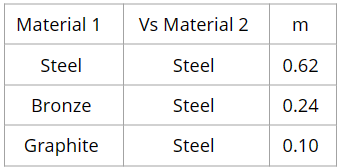
The frictional force is due to several effects involving energy input such as adhesion (the main component of friction), deformation and interaction between asperities.
Points to consider
- The presence of contaminant layers between the brake disc and the friction material significantly reduces the friction forces.
- The presence of a friction force increases the actual contact and sweep area of the intermediate layer (third layer), thus increasing adhesion compared to simple contact.
- It is important to note that at high sliding speeds of one surface against the other, the temperature rises due to the frictional force between the two materials opposing the movement, thus converting kinetic energy into heat (thermal energy) with the consequent rise in temperature of both surfaces.
What is braking?
It should be noted that braking of a moving body is one of the most complex studies in tribology.
When a vehicle is braked, the friction between two materials converts kinetic and/or potential energy into thermal energy. This energy conversion leads to an increase in the overall temperature of the entire system.
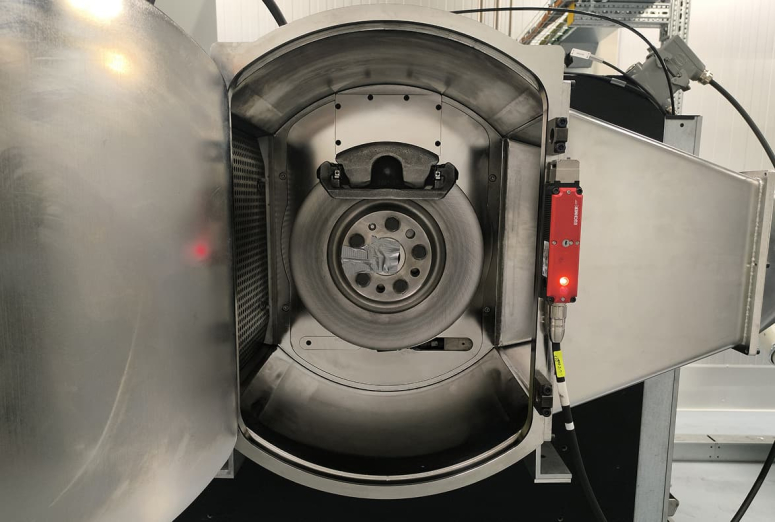
This transformation of energy is caused by the contact between a fixed part, anchored to the axle stub of the vehicle (the brake calliper) and a moving part, rotating with the wheel at the same angular speed (the disc). When the brake pedal is depressed, the circuit is pressurised and the calliper pistons press the brake pads (fixed part) against the disc (moving part).
The contact between the brake pads and the brake disc is where the conversion of energy takes place, so the characteristics of both elements are very specific, since they must be able to withstand high temperatures without excessive wear, but with a good coefficient of friction in order to be able to stop the vehicle.
Finally, the friction coefficient of the friction material must be as stable as possible at different speeds and at different pressures in the braking system, so that the driver can predict the result when trying to decelerate the vehicle.
Therefore, a high quality friction material such as REMSA brake pads and discs is synonymous with safety in the braking system.

REMSA PRODUCTS
Get to know our range of products for cars and commercial vehicles: brake pads, brake disc, brake shoes.



Comentarios
No Comments