
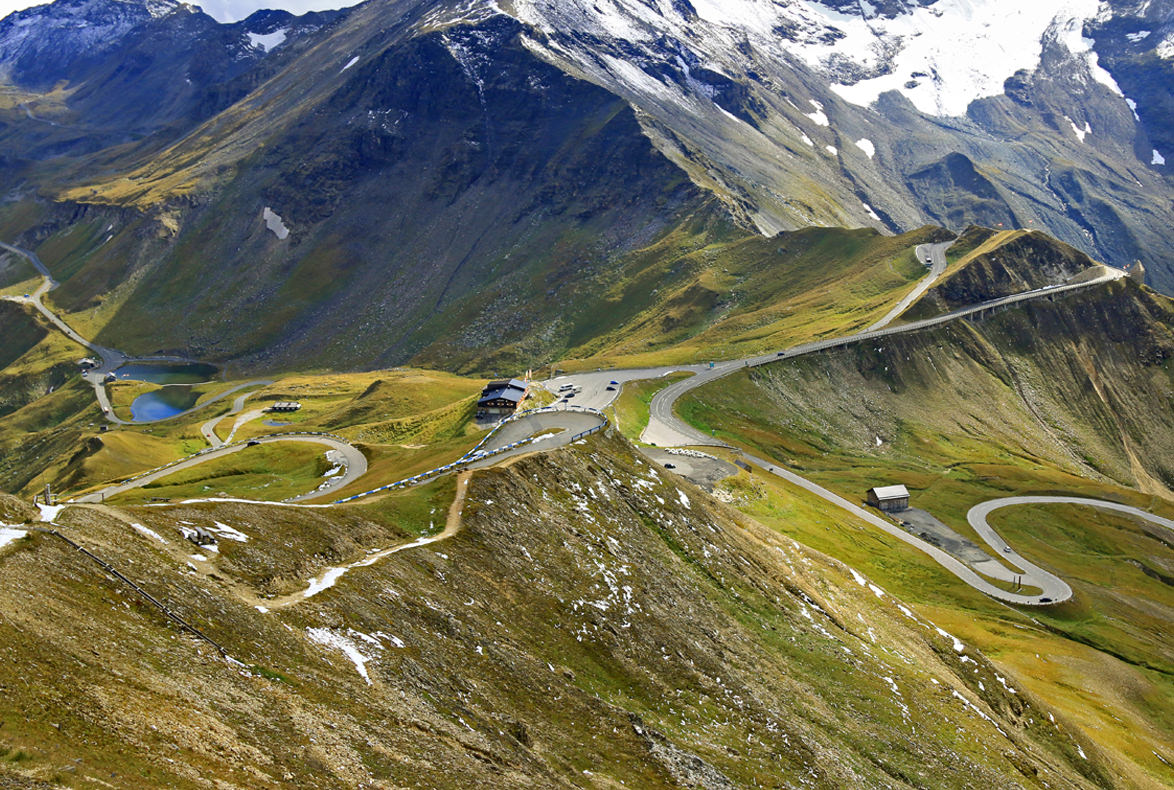


In our blog we also like to drive. That’s why there’s nothing better than summer to take the car out for some breath-taking mountain routes, well equipped with REMSA braking components, because the pedal will be constantly working on the countless descents we’ll be encountering. With a good friction material we will avoid overheating or fading.
Let’s enjoy the trip, the scenery and good company.
This is our suggestion for driving on spectacular mountain roads.
Grossglockner in the Austrian Alps
Yes, we would like to start in the area where we conduct the alpine tests that are fundamental in the R&D of the new friction material.
In particular, we will drive along the spectacular Grossglockner road, located in the heart of the Hohe Tauern National Park. It is the highest mountain pass in Austria and links Bruck in the state of Salzburg with Heiligenblut in Carinthia via the Fuscher Törl and Hochtor Pass at an altitude of 2,504 m.
It costs 28 euros to drive this road and the map that comes with the ticket shows the best places to stop and enjoy the beautiful scenery, such as the Pasterze glacier.
The road runs from Bruck in the Salzach valley through 26 hairpin bends to the Hochtor Pass at 2,428 m with the Edelweißspitze (the place from where our drivers descend to test the REMSA friction material). It will not leave you unmoved.
San Bernardino Pass, Switzerland
Spectacular 33-km mountain pass that links two linguistic areas of Switzerland since it goes from Splügen (German-speaking) to Mesocco (Italian-speaking) with it castle ruins.
The pass is one of the most beautiful in Switzerland, with lakes, waterfalls and vast forests.
On the descent one encounters Lago d’Isola surrounded by mountain forests and glaciers. Ideal for water sports such as rowing, windsurfing or jumping on the zip line. A great place to check brake performance.
Corsica Coast Road, France
We are now driving along a route where we will have to step on the brakes several times. So our braking system had better be equipped with REMSA brake pads and discs.
The coastline of the island of Corsica is a constant up-and-down, with the Mediterranean Sea on one side. Beautiful views, cliffs, flora and fauna will accompany us. The ferry will probably leave us in Bastia, to the north, and there we will be able to visit the Cap Corse and its beautiful beaches. Continue to Calvi, another emblematic coastal town of Corsica, close to the highest mountains of the island and with an impressive citadel.
A two and a half hour drive will take us to Ajaccio, the capital of Corsica and birthplace of Napoleon Bonaparte. In the middle of the gulf stands one of the most beautiful cities on the island, its port and the colours of the city will not disappoint us.
The walled town of Bonifacio, at the southern tip of Corsica, awaits us at the end of the journey. Its beauty is due to its privileged location. It is perched on a rocky promontory of white limestone.
The Dolomites, Italy
The Dolomites massif is located in the extreme north of Italy (South Tyrol). Its landscape is composed of the most important limestone peaks in Europe.
On this occasion, the route will take you from Bolzano, one of the most charming towns in Italy, to Cortina d’Ampezzo, the most glamorous town in the area, full of Austro-Hungarian memories.
All these places are famous for skiing competitions and the Giro d’Italia (the Three Summits of Lavaredo, La Marmolada or the mythical Stelvio).
We pass through large woods and verdant mountains, not forgetting the valley where the beautiful Lake Carezza is located.
Nearby the Gardena Pass will reveal spectacular views over the Sella Towers or Val Gardena.
With so many ports, it is certainly a place to test the brakes of the car.

La Quebrantahuesos, Spain
It runs through the Aragonese Pyrenees and owes its fame to the massive amateur cycling event.
It starts from and arrives in Sabiñánigo (Huesca) and runs through Jaca, a famous Pyrenean city with its imposing citadel, and through well-known mountain passes such as Somport, Marie Blanc and Portalet. From Biescas, the gateway to the Tena Valley (Ordesa Park), it runs down to Sabiñánigo, capital of the Alto Gállego region, a total of nearly 200 kilometres.
The Pyrenean landscape with its peaks, green forests, flora and fauna will accompany us on the route. Nearby we can also take a detour to the Natural Park of the Sierra and Canyons of Guara or reach the region of Sobrarbe with its beautiful villages.
Hopefully the plan will be to enjoy the car and the scenery on one of these routes. Remember that brakes will be important and at REMSA we know all about it.

REMSA PRODUCTS
Get to know our range of products for cars and commercial vehicles: brake pads, brake disc, brake shoes.




Comentarios
No Comments